ClauZ3
Static contracts for agent-authored Python.
ClauZ3 experiments with a different permission surface for agents: the agent writes a small Python program, attaches a contract describing its trusted side effects, and a static prover checks the contract before anything runs.
The contract is the thing the user should be asked to accept. The program is still available for inspection, but a user should not have to read every branch to answer questions like:
- Will this email anyone other than Bob?
- Will this email the same person twice?
- Will this withdraw more than $5 total?
- Will this write outside a sandbox?
In one picture
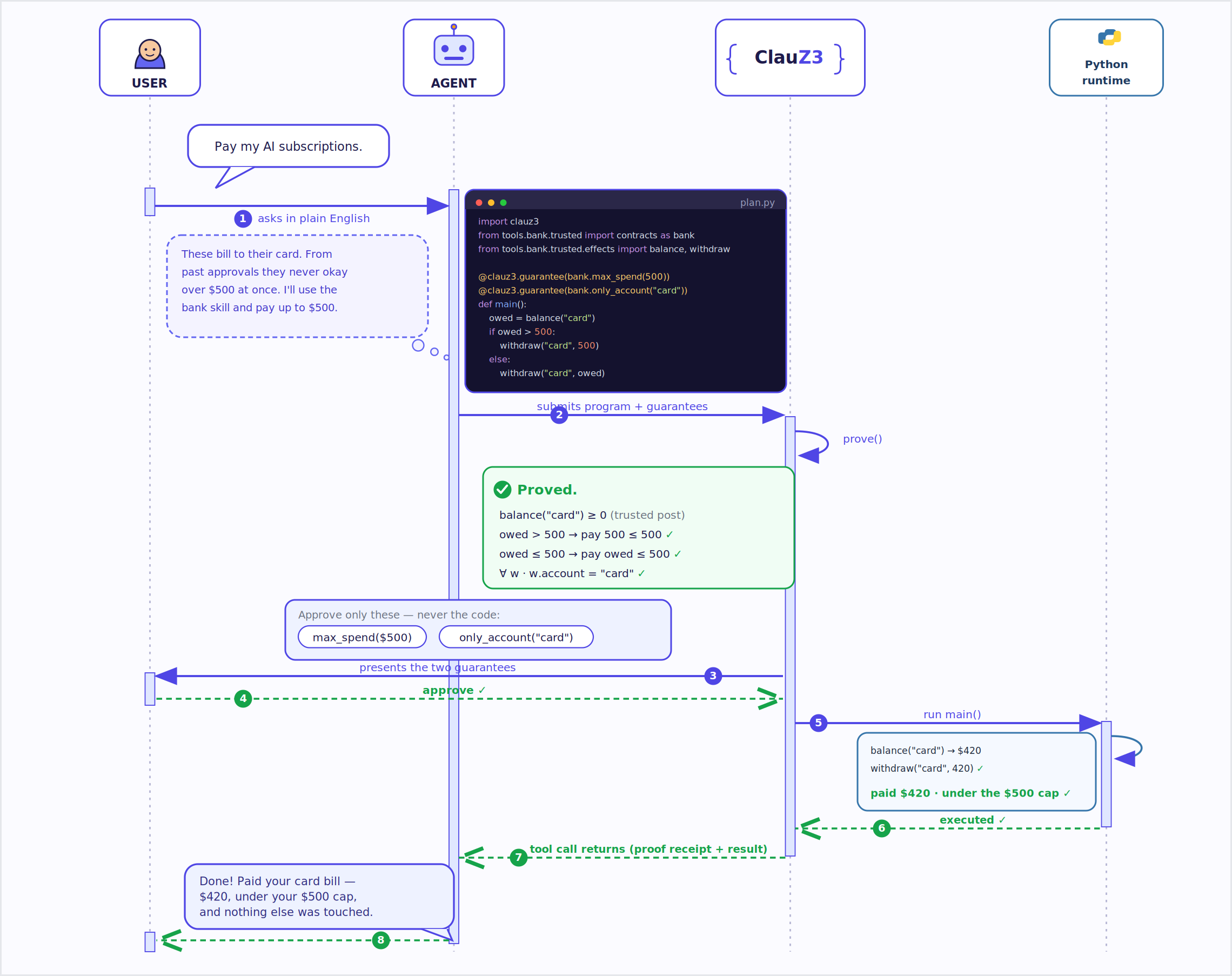
A run, end to end: the user asks for a bill to be paid (capped); the agent
writes a program that looks up the outstanding balance and pays
min(balance, $500); ClauZ3 proves the spend stays under the cap on every
branch and that only the named account is touched; the user approves the
guarantees, not the code; only then does the runtime execute it.
How it fits together
Projects split into two layers:
- Trusted roots such as
tools/email/trusted/: small audited modules containing side-effecting functions and reusable domain contracts. The prover trusts their signatures,@deal.has(...)markers,@deal.pre(...)preconditions, and@contracthelper definitions. - Agent-authored code: ordinary Python that imports trusted functions and
adds
@clauz3.guarantee(...)decorators to the function being proved.
Trusted calls bottom out into symbolic effect facts that domain contracts can query as relations.
Where to go next
- Background and related work — motivation and FORGE comparison.
- Effect specs — the relation algebra over trusted-call facts and its current primitives.
- Coverage policies — how a trusted layer flags or enforces the guarantees an agent should make about a domain it uses.
- ClauZ3 Python subset — supported language for both agent code and contract lambdas.
- Approval service — user-controlled approval boundary, startup, URL discovery, command-line arguments, and REST/UI routes.
- Integration testing — black-box recipe
for
clauz3 runagainst a localhost approval service.
For the full README with worked examples and the current status of the prover, see the project README on GitHub.
Built on


ClauZ3 layers on two upstream projects and would not exist without them:
- deal — the Python runtime contract
engine whose
@deal.pre,@deal.post, and@deal.hasdecorators define the trusted-layer vocabulary. ClauZ3 reads the same decorators and discharges them statically; in runtime-only mode, deal enforces them at execution. - Z3 — Microsoft Research's SMT solver,
the back-end the prover compiles every guarantee into. The vendored
deal-solvermachinery is what bridges Python AST and Z3 constraints.